Libya’s Final “4+4” Election Deal Wins Broad Backing Despite Menfi Decree
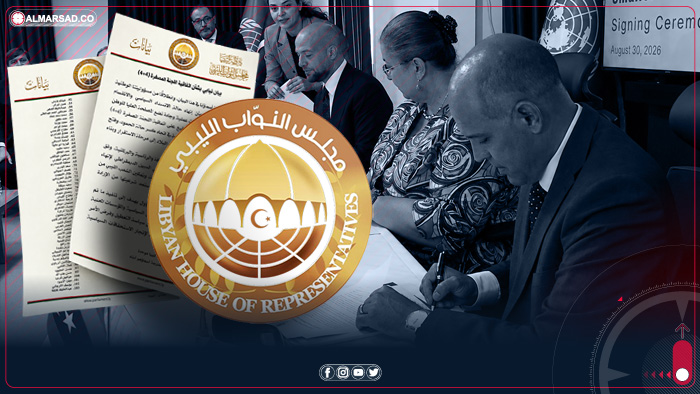
Libya – Representatives of the Government of National Unity, the General Command, the House of Representatives and the High Council of State signed the final “4+4” agreement in Tripoli on Sunday, completing months of UN-facilitated negotiations aimed at removing key obstacles to presidential and parliamentary elections.
The agreement was signed at the headquarters of the United Nations Support Mission in Libya after an inaugural meeting in Rome on April 29 and eight subsequent rounds of talks in Tunisia.
New Electoral Commission
The agreement recommends reconstituting the Board of the High National Elections Commission and appointing Dhaou Ibrahim Al-Hamali Attia as its chairman and Sanaa Al-Lishani as deputy chair.
It also introduces amendments to the legal framework governing presidential and parliamentary elections and sets a deadline of no more than 24 months for holding both votes.
Law No. 28 of 2023 will serve as the basis for the presidential election, with amendments allowing dual nationals and military personnel to vote and run for office under conditions intended to protect the neutrality of the armed forces.
A winning dual-national candidate would be required to renounce any foreign nationality before taking the constitutional oath. The agreement also removes the mandatory second round if a candidate secures more than 50% of the vote, requires 20,000 voter endorsements for presidential candidates and separates the results of the presidential and parliamentary elections.
Law No. 10 of 2014 will provide the framework for parliamentary elections, while responsibility for settling the permanent constitution will pass to the newly elected parliament. The agreement also allows political parties to compete through individual candidates.
One-Month Deadline for Parliament and State Council
The House of Representatives and the High Council of State have one month to approve the agreement in its signed form.
If they fail to do so, the document calls for seeking national adoption through a broadly representative mechanism capable of granting it constitutional status, alongside international endorsement through the UN Security Council.
The signatories and UNSMIL must also establish, within one month, a framework for monitoring implementation of the agreement and the technical, logistical and security measures required for elections.
Al-Lafi: A Breakthrough After a Decade
Walid Al-Lafi, head of the GNU delegation, described the agreement as a landmark Libyan-Libyan accord that had broken through a political barrier left closed for more than a decade.
He said it had created an implementable legal and regulatory foundation for addressing the most significant obstacles to national elections.
Al-Lafi acknowledged that political rivalry would continue but said the parties had demonstrated that direct negotiations could produce common ground.
He added that unifying the executive and military institutions would be a major national gain, but failure to achieve that objective must not become a new excuse for blocking elections.
“The real test begins after the signing, not at the signing itself,” he said.
Bouhmoud: Politicised Provisions Removed
Al-Shibani Bouhmoud, head of the General Command’s delegation, said the agreement was reached after four months of work involving the main Libyan parties, the two councils, the dialogue committee and UNSMIL.
Bouhmoud said the agreement would not provide a “magic formula” for ending Libya’s complex crisis, but represented an essential step towards implementing the UN roadmap.
He described elections as the least costly available means of renewing the legitimacy of state institutions and restoring national decision-making.
Bouhmoud said the negotiating parties had removed what he described as “politicised provisions” inserted into existing laws to obstruct elections. He warned that any official who blocked or delayed implementation would be acting against the national aspirations of Libyans.
He also credited Field Marshal Khalifa Haftar and Deputy Commander-in-Chief Lieutenant General Saddam Haftar with supporting the talks. According to Bouhmoud, Saddam Haftar closely followed the negotiations and instructed the delegation to facilitate compromises whenever discussions reached an impasse.
Haftar: Progress on Issues Stalled for Years
Commander-in-Chief Field Marshal Khalifa Haftar welcomed the final agreement and said it represented progress in resolving issues that had remained stalled for years and prevented Libyans from proceeding towards presidential and parliamentary elections.
Field Marshal Haftar praised the parties involved and affirmed his support for the results, pledging continued efforts to unify Libya and its institutions and end the prevailing state of chaos and division.
Saddam Haftar also welcomed the agreement, describing it as an important step towards removing long-standing barriers to simultaneous presidential and parliamentary elections.
He said the General Command had acted positively and responsibly to narrow differences between the parties, while praising Field Marshal Haftar for supporting the negotiations.
“There is no longer any justification for further delay,” Saddam Haftar said, calling for the next phase to focus on implementation, elections and the reunification of the country.
Hammad Government Calls for Timely Implementation
The Libyan Government headed by Prime Minister Osama Hammad also welcomed the agreement, describing it as an important national step towards breaking the political deadlock and returning to the electoral process.
The government praised UNSMIL for helping the parties reach common ground but stressed that the agreement’s success would depend on every party implementing its commitments according to the specified timetable.
It said Libya now faced a genuine opportunity to move towards one state, unified institutions and a unified national decision.
GNU Prime Minister Abdulhamid Al-Dbeibah similarly welcomed the agreement, saying Libyans must be allowed to end the transitional stages through elections that give state institutions legitimacy derived from the people.
Al-Koni: The Time for Waiting Is Over
Presidential Council member Musa Al-Koni attended the signing ceremony and welcomed the agreement, saying political stagnation and continued waiting were no longer acceptable.
He called for dialogue to produce decisions, agreements to be translated into action and the process to end at the ballot box.
The European Union Delegation and EU member-state missions in Libya also welcomed the agreement and urged the House of Representatives and High Council of State to engage positively with its outcome and take the steps needed for implementation without delay.
Menfi Issues Competing Decree
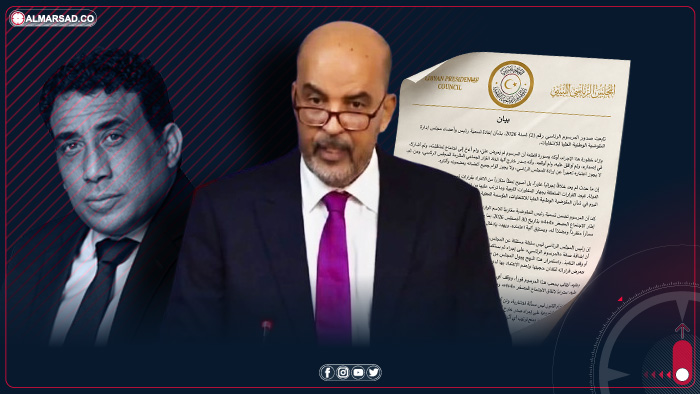
Despite Al-Koni’s support, Presidential Council head Mohamed Al-Menfi issued Decree No. 2 of 2026 shortly after the signing, retaining Imad Al-Sayeh as chairman of the electoral commission while naming Sanaa Al-Lishani as his deputy.
The move directly contradicted the “4+4” recommendation to appoint Al-Hamali Attia as the commission’s new chairman.
Although the decree was issued in the name of the Presidential Council, the council’s decisions are required to be adopted unanimously. Al-Koni’s attendance at the signing and endorsement of an agreement proposing a different commission chairman raised doubts that Al-Menfi’s decree reflected a collective decision, making it appear to be a unilateral step.
Libyan Political Dialogue Forum member Ahmed Al-Sharksi criticised the move, describing Al-Menfi’s attempt to change the commission as “laughable” and arguing that his decisions were neither implemented nor respected.