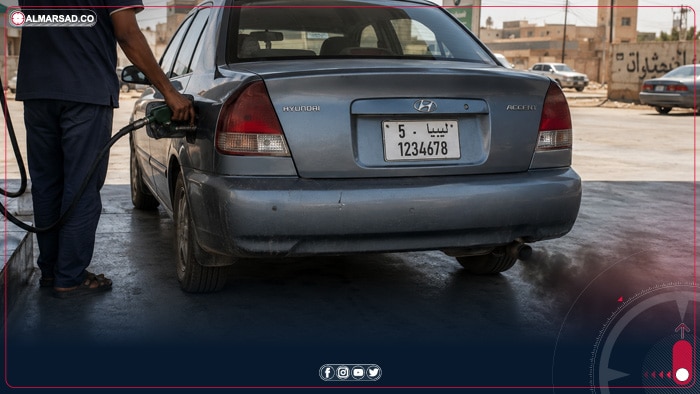
Husni Bey calls for radical reform of fuel subsidies
LIBYA – Businessman Husni Bey has called for fuel subsidies to be lifted entirely or replaced with a one-off cash compensation for citizens, arguing that the current pricing system makes Libyans pay for fuel “two and a half times”, drains public resources and encourages smuggling and speculation. Critics of this approach warned during the discussion of the cost to families of higher prices for bread, water, transport, food and medical treatment.
Debate over the cost to families and the value of compensation
Bey was speaking on the “Hiwariyat Al-Laila” programme on Libya Al-Ahrar TV, which broadcasts from Turkey — followed and summarised by Al-Marsad — during a discussion in which questions were raised about the cost of bread, drinking water, transporting foodstuffs, commuting to work and a patient’s journey for treatment, and whether any study showed that cash compensation would cover the rise in these costs.
Bey replied that what he called the basics of economics confirm that nothing is free, criticising talk of a cost of three cents per litre. He argued that replacing the subsidy would mean citizens pay the price once and receive their entitlements in their accounts to spend as they see fit.
Petrol prices and the cost borne by citizens
Bey described as incorrect a claim by Saber Al-Wahsh that petrol costs 15 qirsh (0.15 dinars), putting its cost at more than a dollar, or about 6.5 dinars; in his general presentation he also cited an estimate of more than a dollar and a half. He said citizens indirectly pay about 14 dinars because the cost of fuel is repeatedly loaded onto the budget.
In his view, the government manages resources but does not own them, and it is citizens who ultimately fund public spending.
$18 billion in nine months and spending estimates
Bey linked inflation to public spending and the deficit, citing remarks by fellow guest Ahmed Al-Senussi that 50% of exports go on fuel, gas and electricity, while explaining that, by his own estimate, the share amounts to half of production itself.
He referred to a statement by Hanna Tetteh about $9 billion over nine months, but estimated the actual cost at about $18 billion if gas and domestic refining were added. He said this was equivalent to about $2,000, or 12,000 dinars, for every Libyan over the same period, and about 9,000 dinars a month per family, according to his calculations.
He also spoke of naphtha remaining unavailable in the south and the north for years, criticising the fact that people are asked to bear heavy spending on a product they do not receive regularly.
Smuggling, corruption, and price and exchange-rate gaps
Bey argued that smuggling, theft, speculation and corruption are consequences rather than the roots of the problem, and that the price gap, which he put at up to 3,000%, creates an incentive to smuggle. He also linked demand for the dollar to an exchange-rate gap he estimated at 50%.
He questioned the point of chasing the symptoms without treating the source of the price gaps, saying the issue should have been tackled about 50 years ago and that the phrase “now is not the time” has no place in economics.
Salaries, the army and police, and parallel budgets
Responding to fellow guest Abdulhamid Al-Fudail’s remarks about the high budgets of the army and police, Bey said the public wage bill stood at 60 billion dinars, according to the figures he cited, and that government, private and public bodies, including the army, the police and the iron and steel sector, also benefit from subsidised gas and naphtha.
He said the cost of the army and police exceeds 50 billion dinars, and that a share estimated at between 20% and 25% of them comes close to the wage bill for 2.2 million Libyans, according to the comparison he presented.
He put this year’s fuel bill at about $20 billion and, when comparing it at the parallel exchange rate, cited a figure of 200 billion. The transcribed remarks used the expression “200 billion dollars” while linking it to a rate of 10 dinars to the dollar, a discrepancy in the unit of account within his original remarks.
He also spoke of spending of 135 billion by the Government of National Unity and 60 billion through other bodies whose spending he described as parallel or of unknown origin, expecting the total to approach 300 billion and stressing that all of it is ultimately borne by citizens.
His position on smuggling accounts and the UN report
Bey rejected the account that fuel is smuggled before it reaches Libyan ports, claiming that a UN report spoke of smuggling by sea after the fuel arrives, not before. He insisted that, in his belief, not a single litre is smuggled before it reaches Libyan tanks.
He added that he had no objection to a trader or smuggler obtaining fuel at its real price: if the cost were 80 US cents, or about six dinars by his calculation, they should pay that, and selling it abroad would then become an export rather than a drain on citizens’ money. Speaking figuratively, he said he would even give whoever did so a framed certificate as an exporter, and that it would then be up to neighbouring countries to stop the fuel entering their territory.
Family allowances and fuel subsidy rates
He argued that keeping the system in place prevents the building of a state or a unified government, and that talk of a cost of 130 billion at the official rate and 200 billion at the parallel rate does not change the fact that it is paid from the people’s money.
He said the child, wife and daughter allowances had stopped only once, in the last three months of 2014, while, by his account, they had been paid every three months over the past six years, rejecting the claim that the government does not pay these entitlements.
He put the rate of fuel subsidy in Libya at about 97%, claiming it was unprecedented worldwide, and compared it with Saudi Arabia, whose subsidy he said had reached only 40% before it was abolished.
Consumption since 1982 and domestic refining
He criticised comparisons of the subsidy’s value between 3 billion and 10 billion that ignore changes in prices and quantities, noting that Libya’s fuel consumption has stood at 10 million tonnes since 1982, according to his estimates.
He added that about two-thirds of consumption has been imported since 2011 and one-third refined locally, after the Ras Lanuf refinery stopped in the same year, whereas most refining had been carried out locally before then. He noted that gas costs running into billions had not been included in some calculations.
Brega, the NOC and the source of funding
Bey addressed Abdulhamid Al-Fudail’s remarks about “revenue collection”, saying the Brega Oil Marketing Company cannot buy shipments if funds are not available, and that funding comes from the public treasury or through external settlements from National Oil Corporation revenues.
He said oil, the Brega company and the corporation’s revenues are all, as he described it, managed through the Dbeibah government and its treasury, and that describing part of the spending as of unknown origin does not justify ignoring the cost borne by citizens.
He asked whether any countries spend half of their natural output, or 50% of their public spending, on fuel and energy, arguing that the Libyan model is unsustainable.
Lifting the subsidy at once, and estimates of poverty and consumption
Bey said he preferred lifting the subsidy 100% in a single day, seeing it as an opportunity to reduce poverty rates, restore the middle class, rationalise spending and cut imports and excessive consumption.
He acknowledged in his presentation that poverty would not be addressed 100%, but expected a significant fall compared with the rates he cited of between 30% and 50%, although the transcribed remarks did not present a detailed study confirming these results.