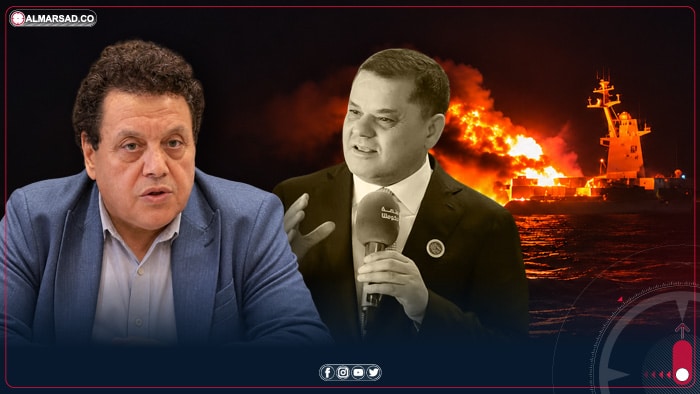
Al-Jehani speaks of parliamentary rifts and foreign interference
LIBYA – House of Representatives member Essam Al-Jehani has said demands to change the House’s leadership and reform its Rules of Procedure date back to the parliament’s inception, accusing unnamed foreign parties of having thwarted earlier attempts to change the leadership and arguing that recent developments concerning the House’s leadership and the maritime agreement with Turkey had taken regional players by surprise.
Speaking on the “Al-Nadwa” programme on Libya Al-Ahrar TV, which broadcasts from Turkey — followed and summarised by Al-Marsad — Al-Jehani said the issue of setting the parliamentary term, and of including an article regulating it in the Rules of Procedure, had been on the table since day one, even though the Constitutional Declaration set the House’s term at 18 months.
He added that MPs had tried to settle the rules on the parliamentary term before choosing the leadership, but that, by his account, the election of Aguila Saleh was followed by continued demands for rotation of the leadership without the required article being adopted, until the House, as he put it, had been reduced to its leadership.
He argued that widening disagreements, once they had come to touch on issues linked to Libya’s sovereignty and national security, made a change of leadership necessary and spurred MPs to rally behind it.
Accusations over the running of the House and budgets
Al-Jehani accused foreign countries which he said benefit from Libya’s division of backing Aguila Saleh’s continued tenure, alleging that representatives of those countries would arrive in Libya, individually and in groups, whenever MPs moved to demand reform, in order to thwart change.
He described Aguila Saleh as having been “on leave” for five years, alleging that the House’s decisions were run from his “sitting room” in Al-Qubba and reached MPs via Facebook without their involvement.
Al-Jehani accused what he described as a “corrupt inner circle” led by Hamid Al-Safi, arguing that Al-Safi had been the de facto head of the House throughout the past five years.
He also alleged that Saleh bears legal and moral responsibility that could follow him even after he leaves the House, speaking of Libyan funds he said had been squandered or had ended up with parties outside the country.
Al-Jehani said he had never seen any budget and had neither attended nor voted on the budget laws for 2017, 2022, 2023 and 2025, arguing that the management of financial files had been reduced to a single person whose decisions were subject to interference by an unnamed foreign state.
He added that, by his account, that state’s interference had kept Saleh away from the actual running of the House for four years and at times made his attendance a formality.
Election of Salehin Abdulnabi and political understandings
Al-Jehani denied that the choice of Salehin Abdulnabi as Speaker had been prearranged, explaining that the reform project and the amendment of the Rules of Procedure were aimed in principle at changing the leadership and setting the parliamentary term, not at choosing a particular person.
He said what took place in the session was the result of understandings between MPs and centres of power in the east and west, pointing to the Dbeibah government, the General Command and the High Council of State.
He added that he had previously put forward initiatives he described as genuinely Libyan, but that they had remained, in his words, in the drawers of the UN Mission and of countries that benefit from the crisis.
He said he saw nothing wrong in communicating with centres of power in the west of the country that others describe as “militia-like”, arguing that some of those running them have a national mindset and fear giving up their weapons to parties that might take their place.
He noted that his meetings with the General Command and with parties in the west had confirmed, in his view, a refusal to submit to foreign interference, expressing hope that the current initiative would help unify Libya and the executive authority.
Maritime agreement with Turkey and regional balances
On the vote on the maritime agreement with Turkey, Al-Jehani said its six-year postponement had been tied more to political balances than to economic considerations, because it had been put forward in wartime and was linked to the joint defence agreement.
He said he wished parliament had voted on the agreement twenty years ago, arguing that its deliberate postponement had helped widen the influence of foreign parties over a file affecting national security.
He argued that the change in the House’s leadership and the approval of the agreement had come as a shock to regional states, while acknowledging that he did not personally know the details of all their moves.
He raised questions about Bahrain’s connection and Egypt’s position, speaking of the dominance of a neighbouring state which he said had backed both sides in the Tripoli war and was still interfering in Libyan affairs, and pointing to what he described as its shifting positions and sudden rapprochement with the head of the Dbeibah government, Abdulhamid Dbeibah.
He also referred to Dbeibah’s meetings with the Turks at the climate conference, saying they had covered details of the maritime agreement and the political initiative.
Controversy over Naji Issa and the appointment of Fawzi Abukhzam
On the Central Bank of Libya, Al-Jehani criticised the appointment of Naji Issa to succeed Al-Siddiq Al-Kabir, saying he had been “parachuted in”, and spoke of the bank’s closure and the crisis over the management of sovereign posts.
He referred to the story of the former candidate “Abdulghaffar”, which he said had come to nothing, to the rise of the dollar, and to what he described as a “small box” that Al-Siddiq Al-Kabir had hidden with Issa, followed by the arrival of an interim governor before the resignation because of the difficulty of carrying on.
He alleged that Hamid Al-Safi had rejected Naji Issa’s resignation through a unilateral decision he signed on behalf of MPs, and that centres of power later decided to remove Issa, who was surprised when his resignation was brought out and accepted, with the House relying on the view that the earlier unilateral decision was legally void.
He said the selection of the new governor, Fawzi Abukhzam, from the board of directors had been achieved through consensus between east and west, but criticised the procedures followed by the new leadership in the vote, noting that he had told it directly of his observations on its performance.
Spy camera and warning of foreign infiltration
Al-Jehani alleged that a spy camera belonging to an unidentified party had been found inside the parliament chamber before the session began, warning that foreign intelligence services had infiltrated MPs’ movements and even their conversations in hotel lobbies.
He stressed that Libya’s interest was a “red line”, calling for those he said were plotting to make the House fail to be confronted before they could impose their tutelage over national decision-making.
Support for the “4+4” committee and the head-of-state scenario
Al-Jehani declared his support for the initiative of the small “4+4” committee, while discussing the initiatives of the UN Mission and envoy Massad Boulos, arguing that small committees are better suited to the task than expanded dialogue committees of forty or fifty members, which he accused of opening the door to bribery, tribal quota-sharing and patchwork solutions.
He said a committee of four or five people could help draw up a consensual electoral law in a first phase, without tailoring it entirely to suit a particular party.
He added that after twelve years of parliamentary work he had come to believe that Libya — as a modern state facing external pressure and competition over its wealth, its geographical location and its small population, and even its religious unity, which he described as coveted — needs at this stage what he called a “just dictator” and a Presidential Council that imposes national decision-making.
Al-Jehani concluded that all scenarios are on the table, including the House moving to appoint a head of state if political initiatives fail or stall, describing this as one of the House’s inherent rights.