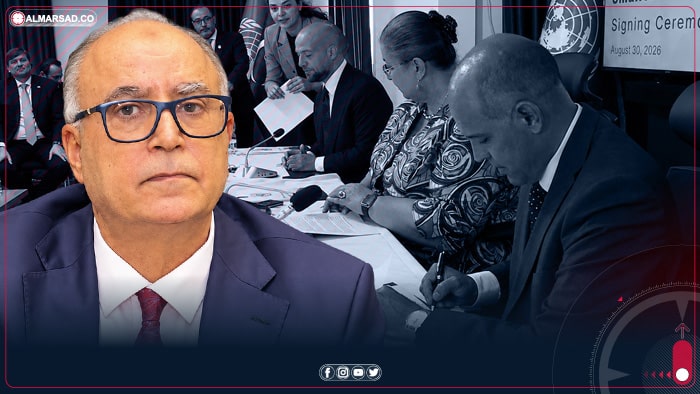
Abdul Aziz defends Al-Gharyani and attacks his critics: he warned of Haftar’s moves as early as 2014
LIBYA – Mahmoud Abdul Aziz, a member of the General National Congress since 2012, has defended dismissed mufti Sadiq Al-Gharyani and his political positions, arguing that Al-Gharyani’s warnings about Field Marshal Khalifa Haftar’s moves since 2014 foreshadowed what eventually became of Haftar’s political and military allies. He also criticised former House of Representatives Speaker Aguila Saleh’s positions on the constitutional judiciary.
Aguila Saleh’s position on the constitutional judiciary
Abdul Aziz, the Dbeibah government’s ambassador to Turkmenistan, was speaking on the programme Between the Lines on Al-Tanasuh channel, which is owned by Al-Gharyani, in comments followed by Al-Marsad. He said Aguila Saleh faced a contradiction in his position on the constitutional judiciary, claiming that Saleh cannot turn to the Constitutional Court set up in Benghazi, which Abdul Aziz alleged is controlled by the parties that removed Saleh from the House presidency, while he does not recognise the Constitutional Chamber in Tripoli.
He criticised those who, he said, are now calling for the judiciary to be rescued after staying silent over legislation that he believes contributed to the current situation.
Insisting on the title of mufti despite dismissal
Abdul Aziz insisted on describing Al-Gharyani as still being Libya’s mufti despite the decisions to dismiss him. He praised what he called Al-Gharyani’s “scholarly standing”, saying he holds two doctorates, while acknowledging that he is not infallible.
Praise for Al-Gharyani’s warnings since 2014
Abdul Aziz praised what he described as Al-Gharyani’s early warnings about Field Marshal Khalifa Haftar’s moves, saying that on 26 February 2014 Al-Gharyani had called them “a full-fledged coup” and urged people to reject them and not support them, a position he kept repeating in the years that followed, up to 2026.
He argued that Al-Gharyani’s positions had, in his assessment, anticipated what became of Field Marshal Khalifa Haftar’s political and military allies, and criticised those who, as he claimed, had ignored those warnings or later credited other figures with foreseeing these developments.
Defence of his positions on Dbeibah and foreign states
Abdul Aziz described Al-Gharyani’s positions as stemming from a political and religious reading of events, noting that he had previously described certain projects as “Zionist, American or Egyptian”, and arguing that these descriptions reflect his convictions rather than any personal interest.
He added that Al-Gharyani also criticises the Government of National Unity headed by Abdulhamid Dbeibah, denying that this criticism stems from any personal feud with him, and calling on critics of Al-Gharyani and of those he described as “Dar al-Ifta scholars” to reconsider their positions.
Abdul Aziz defended the integrity of Al-Gharyani and of those he described as “Dar al-Ifta scholars”, challenging anyone who accuses them of corruption to produce evidence to support the accusations, as he put it.