The Pledge to al-Baghdadi and the Arms-Laden Trawlers: The Full Story of the Man Whose Portrait Appeared on Vehicles at the Al-Arar Rally
Libya – The portrait of Wissam Bin Hamid displayed on the windscreens of several vehicles participating in the Al-Arar Rally in Misrata was no ordinary sticker, nor an innocent expression of nostalgia for a deceased figure. For thousands of families in Benghazi and across eastern Libya, it represents an era of assassinations, bombings, urban warfare, destroyed and booby-trapped homes, car bombs and years of living in fear.
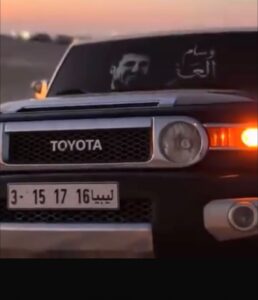
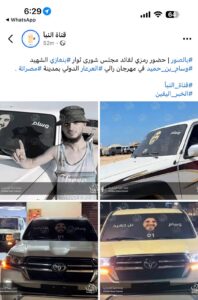
A social media page bearing the name of Al-Nabaa TV described the portraits and the number “01” displayed on the vehicles as a “symbolic presence of the martyred commander of the Benghazi Revolutionaries Shura Council.” Yet the event was secured by official agencies and attended by Government of National Unity Prime Minister Abdulhamid al-Dbeibah, with no public explanation issued by the time of publication regarding how the vehicles were admitted or the security authorities’ position on the glorification of a figure associated with groups designated as terrorist organisations locally and internationally.
The Man Behind the Portrait
Wissam Bin Hamid commanded the formation known as Libya Shield 1 before becoming the military commander of the Benghazi Revolutionaries Shura Council, an alliance established in 2014 that included the UN-listed terrorist organisation Ansar al-Sharia, alongside the Rafallah al-Sahati Brigade, the February 17 Martyrs Brigade and other armed groups.
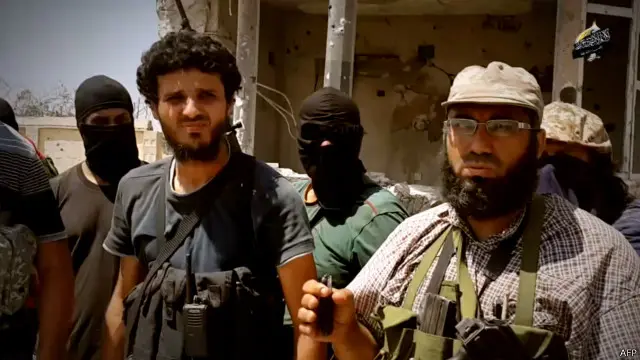
The council was not a political organisation protesting against its opponents. It was an armed coalition that waged war inside Benghazi and fought alongside Ansar al-Sharia and Islamic State group fighters. Bin Hamid appeared in recordings alongside Ansar al-Sharia leader Mohammed al-Zahawi, celebrating the seizure of Special Forces bases and pledging to continue fighting until what he described as “the rule of God’s law” was established.
From Black Saturday to the Assassination of Activists
A year before the Battle of Benghazi began, Bin Hamid’s name was already associated with one of the bloodiest episodes in the city’s recent history. On 8 June 2013, residents gathered outside the Libya Shield 1 headquarters, demanding that armed formations leave the city and that responsibility for security be transferred to the army and police.

The protest descended into an armed confrontation in which Libya Shield forces used heavy weapons and anti-aircraft guns, leaving 32 people dead in what became known as “Black Saturday.”
The killings occurred outside the headquarters of the force commanded by Bin Hamid and involved weapons used by its members. Footage also showed Bin Hamid himself carrying a weapon and firing live ammunition towards the demonstrators. The victims received no meaningful justice until the armed forces ultimately defeated the group.
More serious findings emerged in a 2016 report by the UN Panel of Experts on Libya, which said it had received strong evidence that members of Libya Shield 1, under Bin Hamid’s command, had organised the assassinations of activists, carried out bombings in Benghazi and recruited operatives from among foreign workers.
Ansar al-Sharia, the principal component of Bin Hamid’s council, carried out numerous attacks and assassinations targeting security forces in Benghazi between 2011 and 2014, leaving hundreds of victims, according to the UN Security Council Sanctions Committee. Bin Hamid’s record cannot, therefore, be separated from that of the organisation with which he shared commanders, weapons, bases and battlefronts.
Balance Does Not Mean Absolving Him of Benghazi’s Destruction
The Battle of Benghazi resulted in violations, shelling, civilian casualties and extensive destruction. But balance does not mean equating perpetrators with victims or portraying Bin Hamid as an innocent bystander in a city where he led armed operations, while homes and roads were turned into booby-trapped battlefields.
Human Rights Watch documented the shelling of areas neighbouring positions held by groups affiliated with the Benghazi Revolutionaries Shura Council, killing and wounding civilians and destroying property. The organisation also documented the arbitrary detention of dozens of people.
These groups, alongside Ansar al-Sharia and Islamic State fighters, entrenched themselves in the districts of al-Sabri, Souq al-Hout, al-Leithi, al-Qawarsha and Ganfouda. Streets and houses were converted into barricades, ammunition depots and booby-trapped passageways, leaving entire neighbourhoods reduced to rubble by the end of the fighting.
Arms-Laden Trawlers and Islamic State’s Share
The supplies delivered to Bin Hamid were not entirely shrouded in secrecy. Former General National Congress president Nouri Abu Sahmain later acknowledged that fishing trawlers had transported light weapons with his knowledge to support forces led by Bin Hamid, Jalal Makhzoum and Mohammed al-Oraibi, known as “Boka.”
In a widely circulated video testimony, Hamid Khadr, described as a Misrata notable and commander, said he had asked Bin Hamid during a visit to the city whether ammunition dispatched from Misrata was reaching Islamic State fighters in Benghazi.
According to Khadr, Bin Hamid replied: “Of course, because they are holding the al-Leithi front for us,” before reportedly explaining: “We fight alongside anyone who fights Haftar.”
The testimony corresponds with the documented battlefield alliance between the Shura Council and Islamic State, as well as admissions by figures close to Bin Hamid that he fought alongside the organisation. If accurate, it means the ammunition arriving by sea did not remain exclusively in the hands of the Shura Council but also reached Islamic State fighters and was shared with them according to the needs of their common front.
A Pledge Confirmed by Allies Before Opponents
Evidence of Bin Hamid’s relationship with Islamic State did not come solely from media outlets affiliated with the Libyan armed forces.
In a widely circulated broadcast dating to 13 December 2017 on Libya Al-Ahrar TV, Noman Benotman, then president of the Quilliam Foundation for counter-extremism, said the US Central Intelligence Agency had confirmed Bin Hamid’s membership of Islamic State.
Benotman later said he was convinced “without any doubt” that Bin Hamid had pledged allegiance to the organisation during a brief visit to Syria in 2015. Abu Bakr al-Baghdadi was Islamic State’s leader and the recipient of the organisation’s general pledge of allegiance at the time.
Abdulrazak al-Aradi also acknowledged that Bin Hamid had entered into a “combat pledge” with Islamic State and said Bin Hamid had personally disclosed the agreement during a meeting in Misrata.
The significance of these statements lies in the fact that they did not come from an armed forces spokesperson or a media outlet supporting Operation Dignity. They came from figures and platforms that stood in opposition to the armed forces at the time—making them admissions from the opposing camp, rather than accusations levelled against it.
An Affront to the Memory of the Victims
For the families of soldiers, police officers, judges, activists and civilians killed in Benghazi, Bin Hamid’s portrait does not represent a political disagreement that can simply be overlooked. It represents the rebranding of a commander from a bloody era as a hero.
It is an affront to a mother who lost her son in an assassination, to a family that returned home to find its house reduced to rubble, and to an injured survivor who still carries fragments from a war that may have disappeared from the headlines but never ended in his life.
The impact of the portrait extends to Derna, whose residents endured Islamic State rule, assassinations and executions, and to communities across eastern Libya that paid the price of years of terrorism. The victims do not see merely the face of one man; behind it, they see his allies, their flags, car bombs and trawlers loaded with ammunition.
A City Whose Sons Still Bear the Scars of Islamic State
The location where Bin Hamid’s portrait was displayed makes the episode still more striking. The final declared toll from Operation Bunyan al-Marsous against Islamic State in Sirte stood at 730 dead and more than 6,000 wounded, including 4,269 officially registered cases.
The health minister at the time spoke openly of amputees and people left paralysed who required long-term treatment and social security payments. Most of the fighters who fought in Sirte came from Misrata, according to Reuters.
Those men were absent from the rally images: the young fighters who returned to their families in coffins and those who returned with bodies that would never be the same, having fought to bring down al-Baghdadi’s flag only a few hours away from their city.
How, then, could the portrait of a man who entered into a combat pledge with the same organisation pass through the streets of Misrata, among its residents and before its wounded, as though nothing had happened?
If Misrata—the city of Bunyan al-Marsous—is allowed to forget Sirte and the sons who lost limbs fighting Islamic State, who will remember them? If the portrait of an Islamic State ally can pass under the eyes of security forces in the city that helped defeat the organisation, the military battle may be over, but the battle over memory is clearly not.
Where Is the Dbeibah Government?
The presence of these vehicles at an officially secured event attended by the prime minister requires the Interior Ministry and the Misrata Security Directorate to explain what happened, identify those responsible for displaying the portraits, examine their backgrounds and determine whether participants knowingly endorsed the display.
The authorities must also state clearly where they stand on the glorification of commanders associated with terrorist organisations.
Terrorism does not always return in the form of a suicide belt or a car bomb. Sometimes it returns as a polished portrait on a vehicle’s windscreen, taking advantage of a short public memory and a silent state.
When the commander of an era of bloodshed and destruction is allowed to return as a “symbol,” the victims feel that they have been killed twice: once by the weapon and once by forgetfulness.