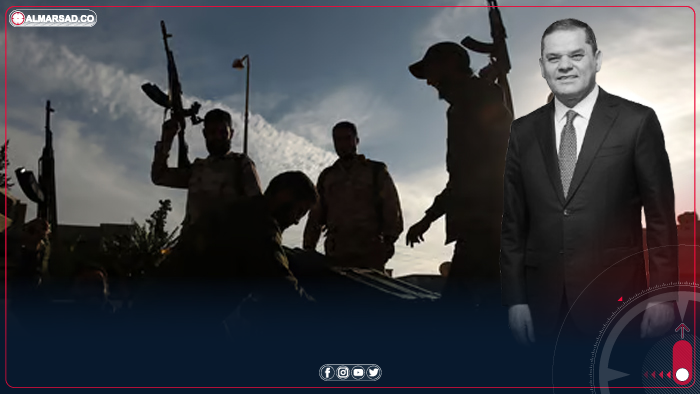
Call to rethink Europe’s bet on Dbeibah
Libya – An analytical report published by the US research centre Middle East Forum argued that what it called Europe’s misreading of the situation in Libya is deepening the continent’s energy crisis, saying cooperation with the General Commander of the Armed Forces, Field Marshal Khalifa Haftar, rather than with Tripoli-based Prime Minister Abdulhamid Dbeibah, would be a vital option to offset a shortfall in Saudi oil shipments with Libyan crude.
Reading of Europe’s supply crunch
The report, which Al-Marsad followed and whose main analytical points it translated, said panic had spread among European officials after Saudi Arabia announced it could no longer continue shipping oil to their countries, adding that European investment contracts in alternative energy had not met demand.
It argued those contracts had driven prices higher without meeting basic energy needs, and that Europe now recognised its need for fossil fuels, warning that their absence could force European capitals to ration petrol or cut industrial activity.
Eastern Libya and oil infrastructure
The report cast eastern Libya as a possible way out of the crisis, saying the Armed Forces control more than 70% of the country’s territory, including oilfields, pipelines and the main export terminals, despite what it called the lingering “Benghazi knot” linked to the killing of former US ambassador Christopher Stevens.
The report’s account of the conflict since 2011
It traced the roots of the problem to 2011 and the bloody overthrow of the late Colonel Gaddafi, saying the country briefly slid into chaos before Field Marshal Khalifa Haftar rallied citizens to reclaim their country, in the report’s wording.
It added that the goal was achieved at a human cost of more than 5,000 Libyans, and consisted of restoring order across eastern Libya by eliminating, imprisoning or forcing out members of armed militias from areas they controlled, according to the report’s account.
The report described Libyans as people of common sense who understand the vast natural wealth their country holds, arguing that while they are religiously and socially conservative as individuals, they recognise that political Islamist groups and hardliners bring only misery. It accused those groups of using religion to distract from their corruption, mismanagement and, often, loyalty to foreign parties rather than seeking to protect the faith.
2014 elections and criticism of appeasement
The report said the victory of the non-Islamist current in the 2014 legislative elections was unsurprising, but that it had, in the report’s telling, alarmed Hillary Clinton and her aide Jake Sullivan — identified as the then US secretary of state and her aide — as well as then UN Secretary-General Ban Ki-moon, UN envoy Ian Martin and European officials.
It attributed that to political Islam turning to armed rebellion after being sidelined at the ballot box, and argued that the US, UN and European response took the form of an appeasement policy under which the winners were forced to accept a prime minister from the losing side in Tripoli, whom the United Nations recognised as the country’s legitimate leader.
Claims about Dbeibah and an airport comparison
The report said Abdulhamid Dbeibah currently holds that post, describing him as a front for a Misrata business family. It claimed most Libyans view him as a “bumbling fool” barely able to form two coherent sentences, and accused him of caring more about promoting Islamist thought and amassing personal wealth than about rebuilding Libya.
It cited Tripoli International Airport remaining out of service and flights being diverted to Mitiga International Airport, which it described as a former military base, against the renovation of Benghazi’s old Benina International Airport and work to complete a new ultra-modern airport on the other side of the city, which it said was designed to rival airports in Dubai and Qatar.
Security and ties with Turkey and Qatar
The report saw a wide gap in the security picture, saying Benghazi, Sirte, Derna, Tobruk, Sebha, Al-Qatrun and Taraghen generally enjoy security and stability, while Tripoli and Misrata remain, in its description, safe havens for armed militias, comparing the two cities more to Mogadishu than to Milan.
It accused Dbeibah of seeking to shore up Turkish and Qatari support and to obtain money from both to stay in power and carry out their dictates, including promoting political Islam and awarding Libyan contracts to Turkish and Qatari firms and institutions, alongside backing broader Turkish claims over maritime boundaries in the eastern Mediterranean.
The report called Dbeibah a “puppet” and a “Trojan horse”, claiming he lacks real popular support inside Libya and that his theoretical term ended years ago, and urged European leaders to ask what justifies recognising a party it said enables militias and shows limited capacity for stability and development, against a party it cast as able to deliver security and control of territory and oil infrastructure.
Sovereignty and Benghazi as a seat of authority
The report rejected labelling Field Marshal Khalifa Haftar and the Armed Forces’ Deputy General Commander, Lt Gen Saddam Haftar, as separatists, arguing they defend sovereignty more than those it described as ready to sell it to Ankara or Doha, or as adherents of ideologies that ignore national borders. It added that making Benghazi their seat of authority is not aimed at dividing the country.
Oil that bypasses Hormuz and Bab al-Mandab
It argued that directing Europe’s energy security towards Libya would allow oil to flow without passing through the Strait of Hormuz, Bab al-Mandab or the Suez Canal, calling for cooperation under the current crisis and for abandoning what it called the mistakes of Clinton and Ban Ki-moon.
It added that the US State Department still clings to that approach, urging Europe to acknowledge reality and move to cooperation that brings mutual benefit, not merely serves its own interests, and claiming that Libyans — including Tripoli residents — want an end to the international experiment built on appeasing political Islam.
Call for an oil deal and criticism of European diplomacy
The report argued that cooperation with Field Marshal Khalifa Haftar would let Europeans raise oil imports from Libya and offset the Saudi shortfall, describing the General Commander of the Armed Forces as direct and clear, and as positioned to strike a deal Dbeibah cannot conclude.
It closed by criticising European diplomats it called indolent and insistent on betting on Dbeibah, arguing that if their governments remain idle they will deserve the chaos it warned could soon hit Europe.