Oglu links ratification to political and institutional rapprochement
LIBYA – Turkish political analyst Firas Oglu has described Ankara’s rapprochement with eastern Libya, after six years of rejection, as an excellent step that, in his view, reflects the success of Turkish policy towards both east and west and its pursuit of a unified Libyan state.
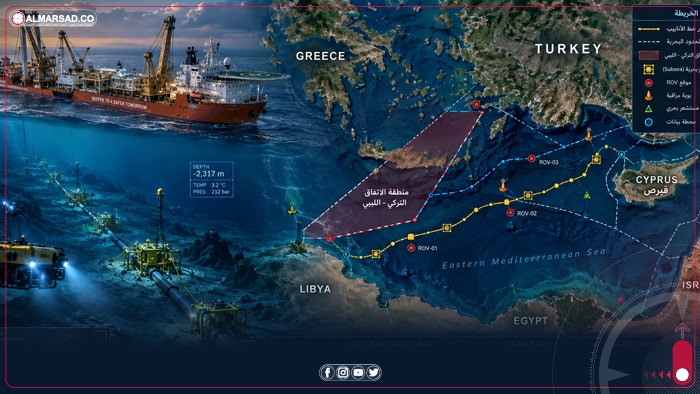
In a phone interview on a Libya Al-Ahrar TV news bulletin, which broadcasts from Turkey — followed and summarised by Al-Marsad — Oglu said these developments were a major gain for bilateral relations and for the Eastern Mediterranean file, after Ankara had managed to entrench the memorandum of understanding and turn it into a declared agreement.
The Mediterranean and disputes with Israel and Greece
He explained that, amid the Turkish-Israeli dispute and the disagreement between Turkey on one side and Greece and Israel on the other in the Eastern Mediterranean, Ankara and Libya had been able to take a firm step beyond the memorandum of understanding, after convincing the various Libyan parties, particularly the House of Representatives, that it genuinely serves Libyan interests.
Oglu linked the development to what he described as dangerous Israeli expansion in Gaza and southern Syria, the bombing of Iran, and Israeli efforts, with US help, to extend its influence even into Somaliland.
He added that an Israeli-Cypriot-Greek axis could deprive Libya of important gains, and that Turkey would, in his assessment, take positions in the absence of a direct military confrontation with Israel and Greece. He argued that the official agreement and the semi-official maritime delimitation open the way for future transactions and projects.
Turkish companies, energy and joint agreements
On the economic front, Oglu said Turkish companies had managed to enter eastern Libya in oil, exploration and the eastern coast, with Turkish workers present and growing economic interests.
He affirmed that the efforts launched recently within the 4+4 framework, and the agreements concluded, were continuing with a view to establishing joint institutions between the east and west of the country. He pointed to a shift in Ankara’s policy towards supporting a unified Libya and bringing the parties together to move to a new phase.
Egypt’s position and the future of Libya’s institutions
On the regional front, he said Egypt had perhaps entered an informal alliance out of a wish to help Saudi Arabia, citing what he called the “Mecca agreement”. He said Cairo appeared to be taking part in this context without a formal signature, and that these arrangements were connected to the Libyan file.
He concluded that, in his reading, Libya was moving internally towards expanding joint institutions between east and west and seeking formulas for unifying civilian institutions, to be followed at a later stage by the military and security institutions.