Medical Supply Organization sets out each body’s responsibilities in the insulin crisis
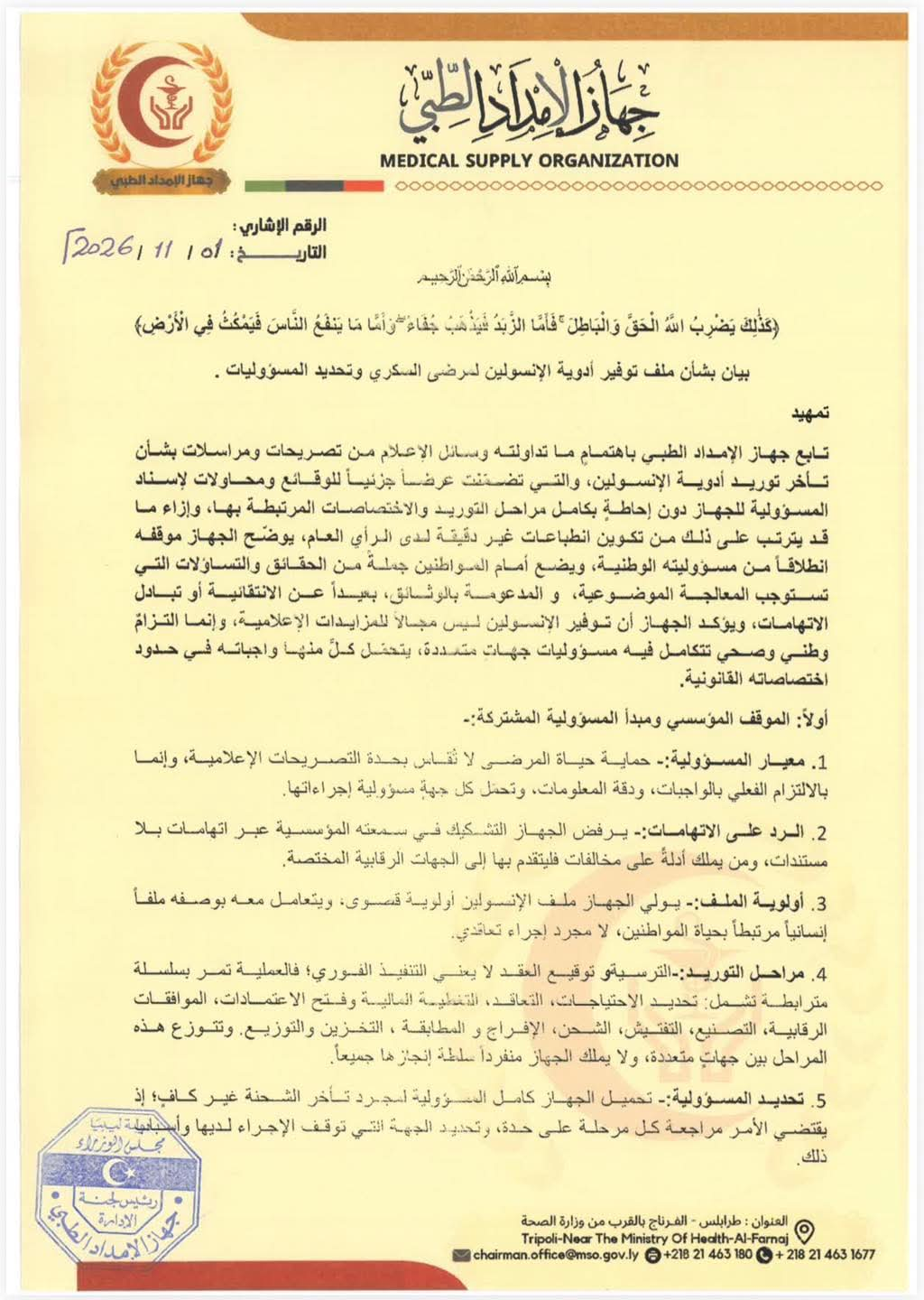
LIBYA – The Medical Supply Organization has rejected being held solely responsible for delays in supplying insulin to diabetes patients, saying the crisis stems from overlapping failures in determining needs and in financial, oversight, contractual and distribution procedures, and calling for a review of each body’s responsibility according to its remit.
In a statement received by Al-Marsad, the organisation said it had followed media statements and correspondence about the delay that, in its words, presented only part of the facts and sought to pin the blame on it without considering the various stages of procurement and the bodies involved in them.
It said that passing judgement on the basis of partial information could create inaccurate impressions among the public, and that it was therefore setting out its position in detail for citizens, along with questions it said required an objective, documented review rather than an exchange of accusations.
It stressed that providing insulin is a national and health obligation to protect patients’ lives, not a matter for media point-scoring, and that responsibility for it is shared and divided according to each body’s legal powers.
Shared responsibility and the stages of medicine procurement
1. Standard of responsibility: protecting patients’ lives is measured not by the sharpness of media statements but by actual commitment to duties, accurate information, and each body taking responsibility for its own procedures.
2. Response to accusations: the organisation rejects attempts to cast doubt on its institutional reputation through undocumented accusations; anyone with evidence of violations should submit it to the competent oversight bodies.
3. Priority of the file: the organisation gives the insulin file top priority and treats it as a humanitarian issue bound up with citizens’ lives, not merely a contractual procedure.
4. Procurement stages: awarding a tender and signing a contract do not mean immediate delivery. The process goes through an interlinked chain that includes determining needs, contracting, financial cover and opening letters of credit, oversight approvals, manufacturing, inspection, shipping, release and conformity checks, storage and distribution. These stages are spread across several bodies, and the organisation alone does not have the power to complete them all.
5. Determining responsibility: holding the organisation fully responsible simply because a shipment is late is not enough; each stage must be reviewed separately to establish where the procedure stalled and why.
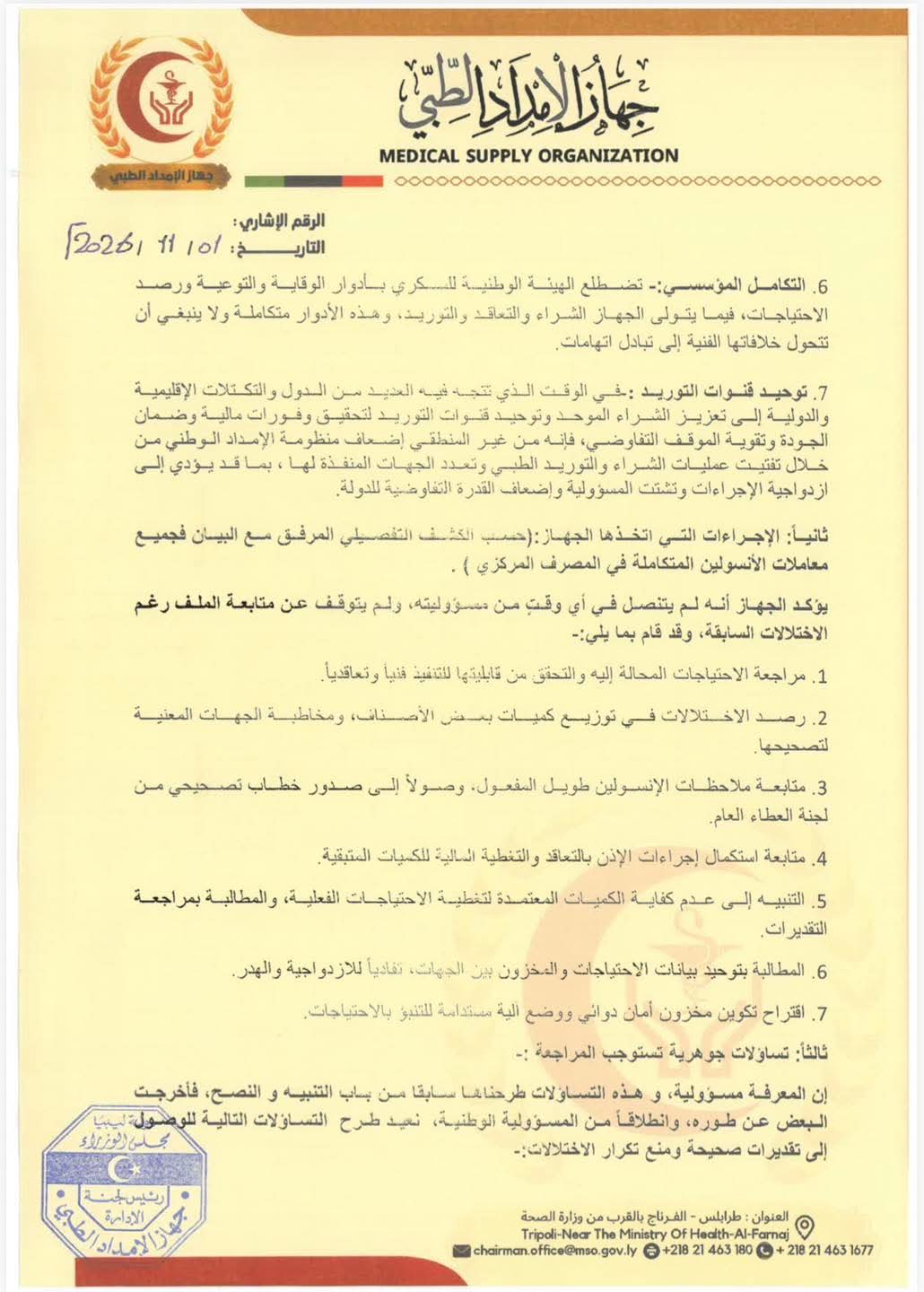
6. Institutional complementarity: the National Diabetes Authority is responsible for prevention, awareness and monitoring needs, while the Medical Supply Organization handles purchasing, contracting and supply. These roles are complementary, and technical differences between them should not turn into an exchange of accusations.
7. Unifying supply channels: at a time when many countries and regional and international blocs are moving to strengthen joint purchasing and unify supply channels to achieve savings, guarantee quality and strengthen their negotiating position, it makes no sense to weaken the national supply system by fragmenting medical procurement and supply and multiplying the bodies that carry them out. This could lead to duplicated procedures, diffused responsibility and a weaker negotiating position for the state.
The organisation’s measures to address the insulin crisis
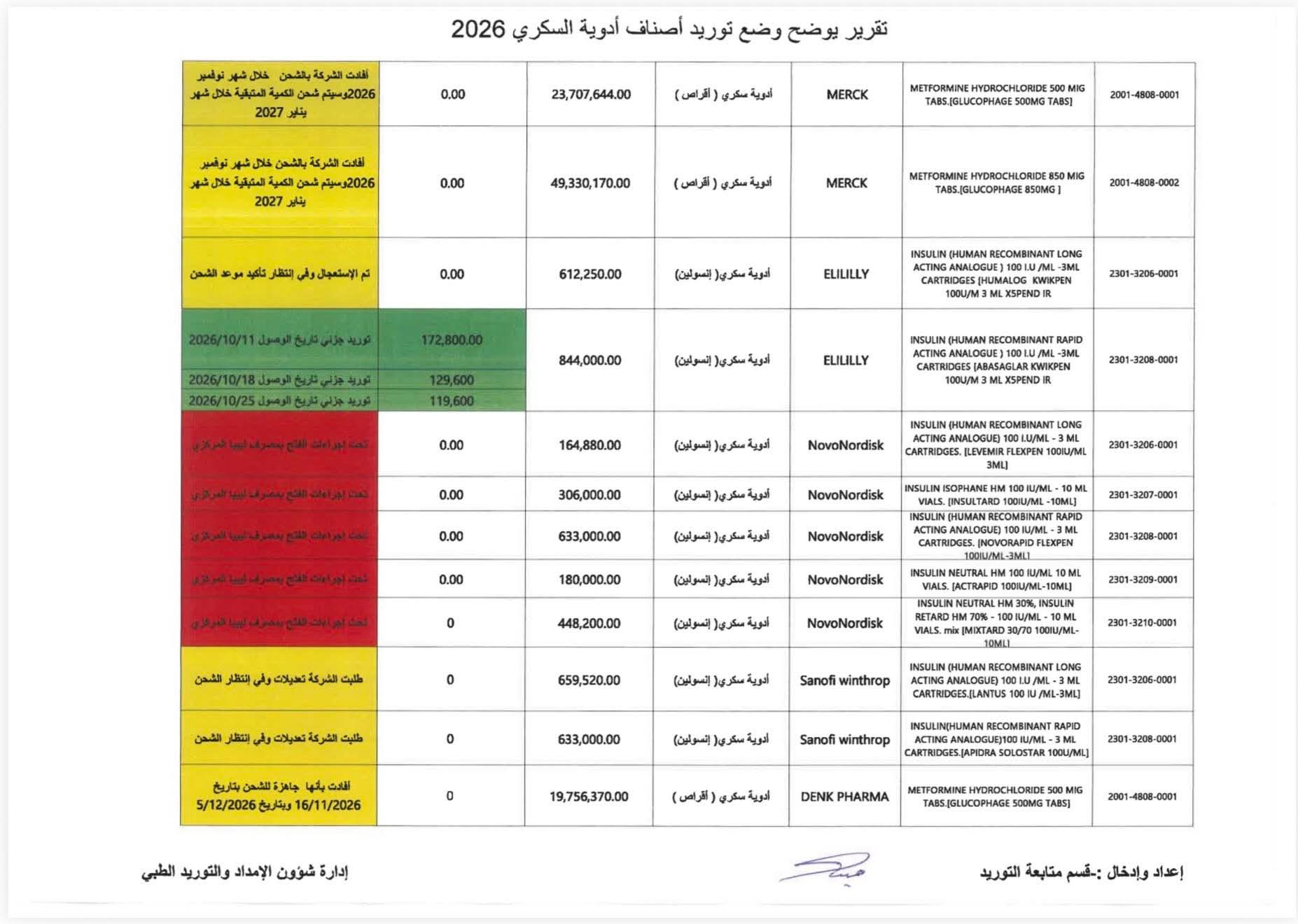
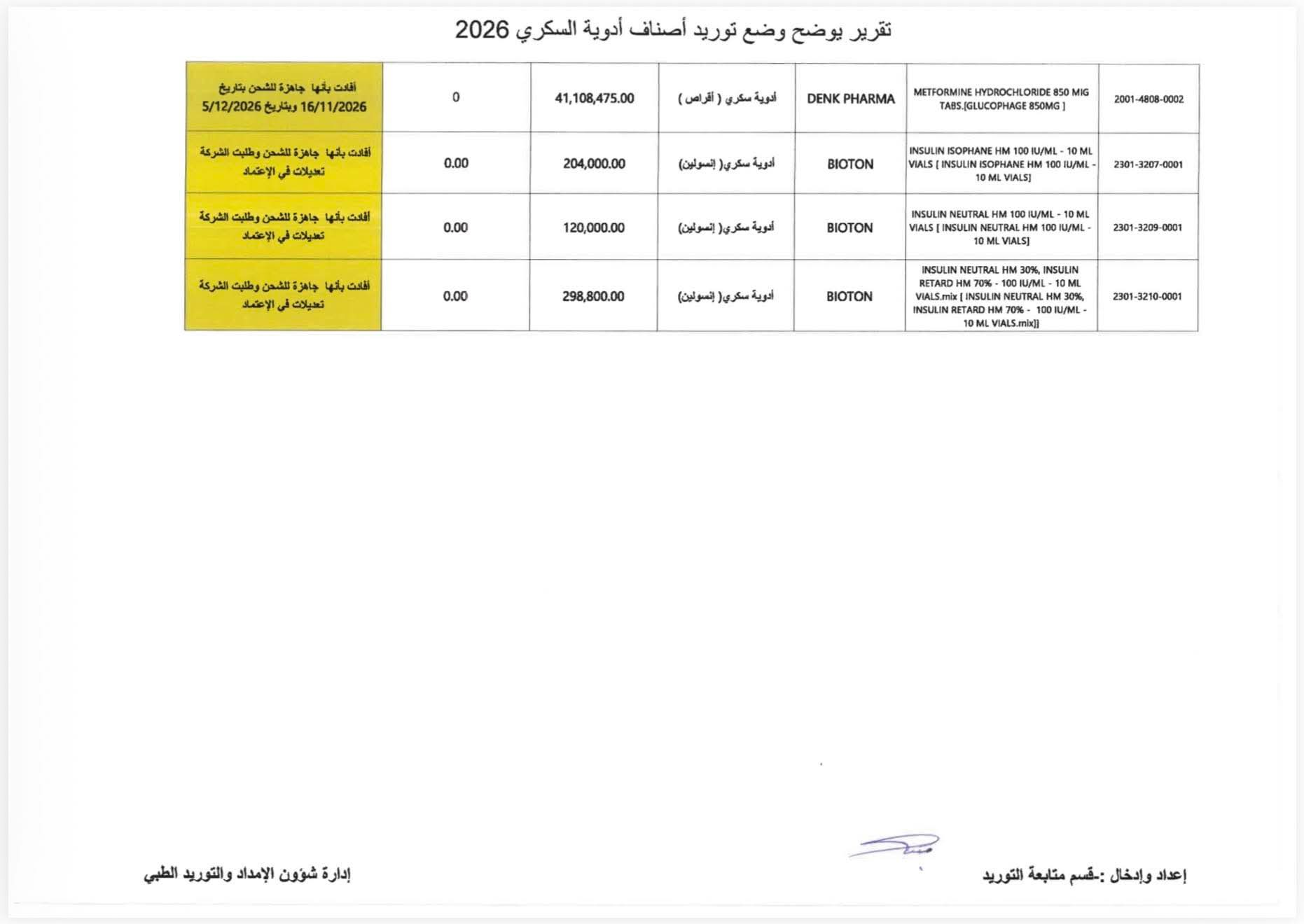
The organisation said it had continued to follow up the file and had not abandoned its responsibilities despite earlier failures. It listed seven measures it had taken, according to what it described as the attached detailed list, which it said showed that the insulin transactions with the Central Bank were complete.
1. Reviewing the needs referred to it and checking whether they could be met technically and contractually.
2. Identifying imbalances in the distribution of quantities of some items and writing to the bodies concerned to correct them.
3. Following up observations on long-acting insulin, leading to a corrective letter from the Public Tender Committee.
4. Following up the completion of contracting authorisation and financial cover for the remaining quantities.
5. Warning that the approved quantities were insufficient to cover actual needs, and calling for the estimates to be reviewed.
6. Calling for needs and stock data to be unified across bodies to avoid duplication and waste.
7. Proposing the creation of a medicine safety stock and a sustainable mechanism for forecasting needs.
Questions over 2025 and 2026 needs and distribution
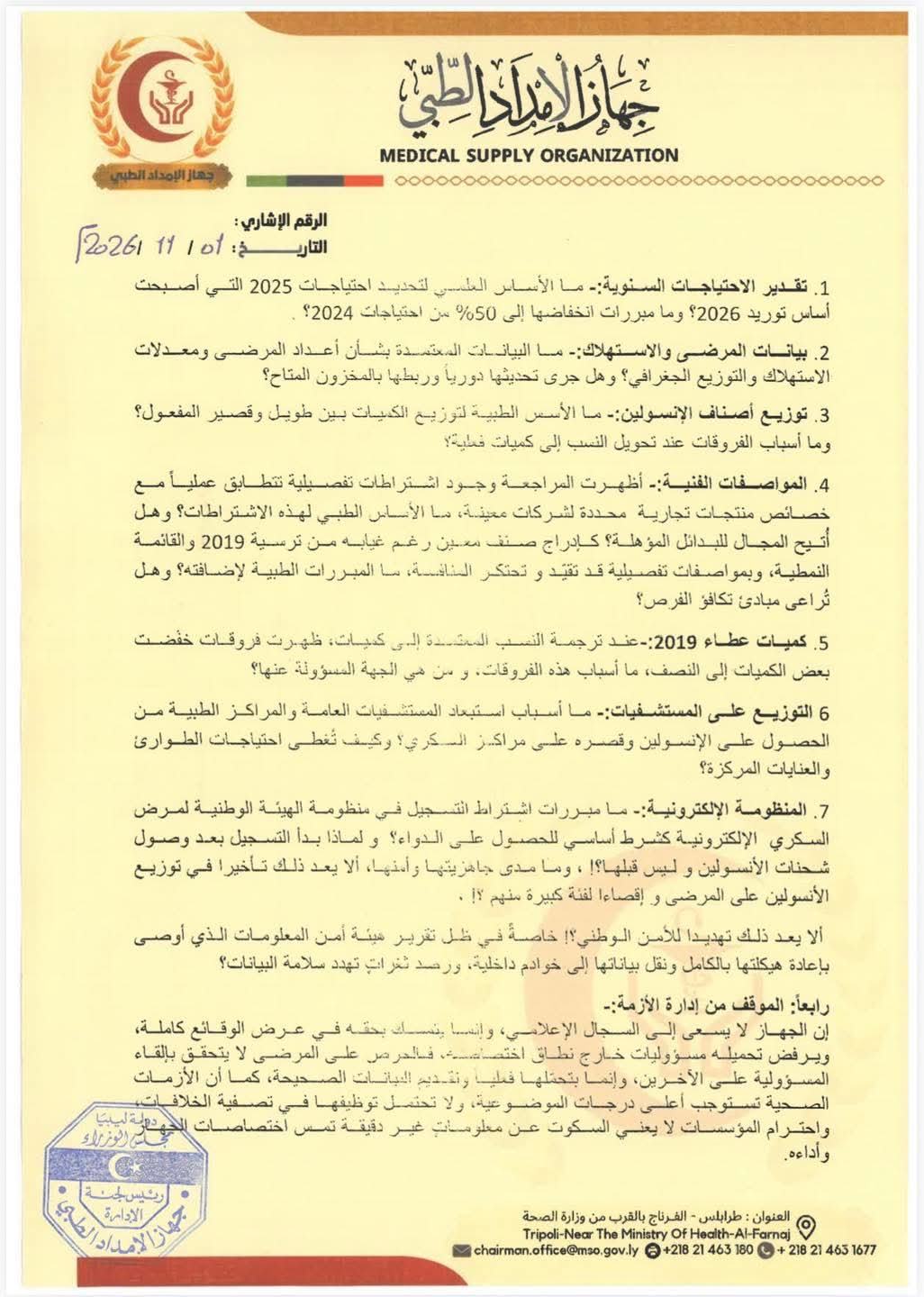
The organisation said it had raised questions about needs and distribution earlier and was raising them again to correct the estimates and avoid a repeat of the failures, as part of what it described as its national responsibility, noting that raising them before had drawn sharp reactions from some parties.
1. Annual needs estimates: what is the scientific basis for setting the 2025 needs that became the basis for 2026 procurement, and what justifies their reduction to 50% of 2024 needs?
2. Patient and consumption data: what data have been adopted on patient numbers, consumption rates and geographical distribution? Have they been updated regularly and linked to available stock?
3. Distribution of insulin types: what is the medical basis for dividing quantities between long-acting and short-acting insulin, and what caused the discrepancies when the percentages were converted into actual quantities?
4. Technical specifications: the review found detailed requirements that in practice match the characteristics of specific commercial products made by particular companies. What is the medical basis for these requirements, and were qualified alternatives given a chance? One item, for example, was included despite its absence from the 2019 tender award and the standard list, with detailed specifications that could restrict competition and create a monopoly. What is the medical justification for adding it, and are the principles of equal opportunity being respected?
5. 2019 tender quantities: when the approved percentages were translated into quantities, discrepancies emerged that cut some quantities by half. What caused these discrepancies, and which body is responsible for them?
6. Distribution to hospitals: why have public hospitals and medical centres been excluded from receiving insulin, with supplies restricted to diabetes centres? How are the needs of emergency departments and intensive care units being met?
7. Electronic system: what justifies making registration on the National Diabetes Authority’s electronic system a basic condition for obtaining the medicine? Why did registration start after the insulin shipments arrived rather than before? How ready and secure is the system, and does this not delay the distribution of insulin to patients and exclude a large number of them?
In its statement, the organisation asked: “Does this not pose a threat to national security, especially in light of the report by the Information Security Authority, which recommended a complete restructuring of the system and the transfer of its data to domestic servers, and identified vulnerabilities threatening the integrity of the data?”
Rejecting crisis management through media sparring
The organisation said it was not seeking a media row, but insisted on presenting the facts in full and rejected being held responsible for matters beyond its powers. It argued that protecting patients requires accurate data and each body shouldering its duties, rather than settling scores or trading accusations, and that respect for institutions does not mean staying silent about information it considers inaccurate and damaging to its remit and performance.
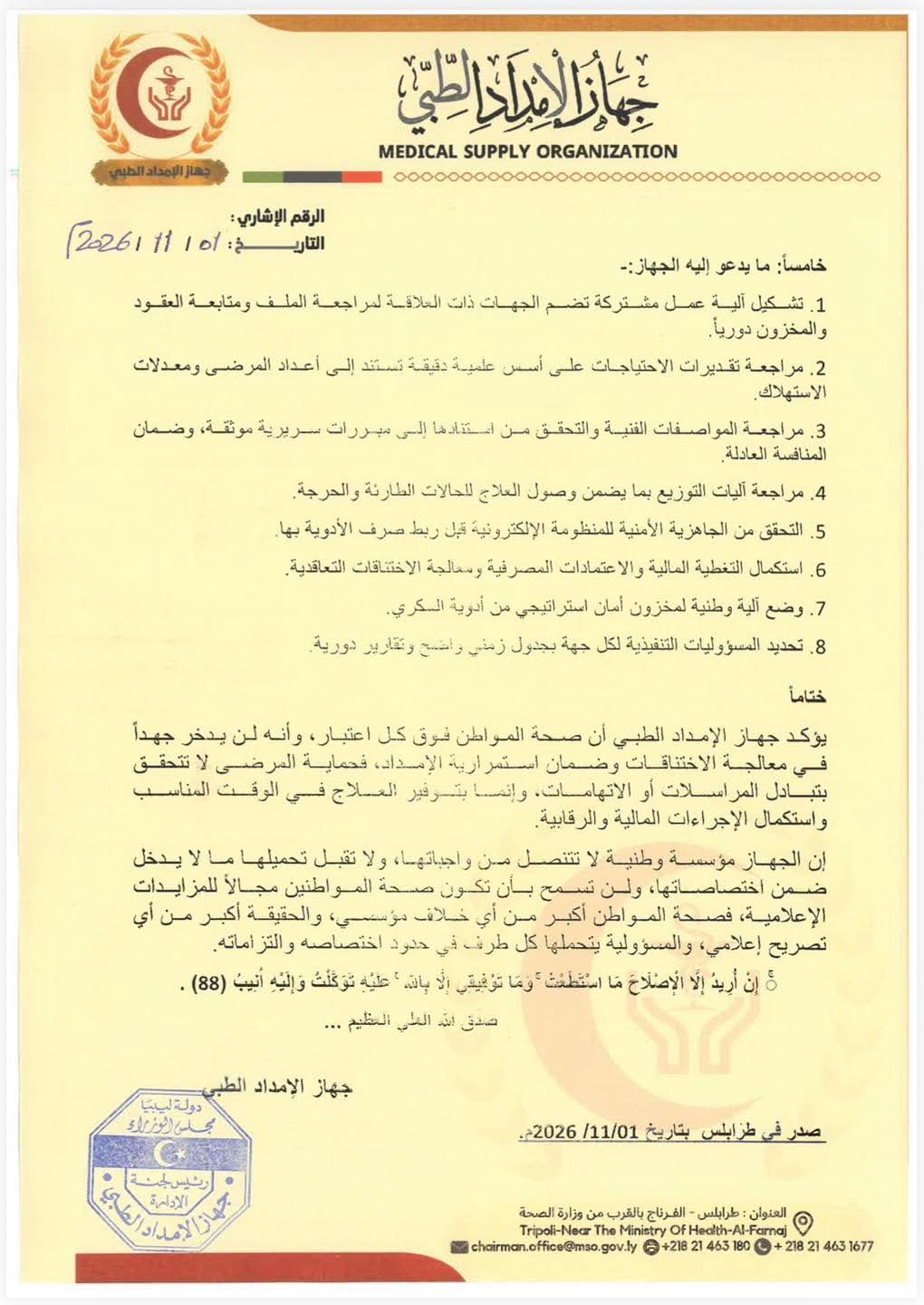
Eight demands to secure and distribute insulin
1. Setting up a joint working mechanism bringing together the relevant bodies to review the file and monitor contracts and stock regularly.
2. Reviewing needs estimates on a precise scientific basis drawn from patient numbers and consumption rates.
3. Reviewing technical specifications, verifying that they rest on documented clinical justifications, and ensuring fair competition.
4. Reviewing distribution mechanisms to ensure treatment reaches emergency and critical cases.
5. Verifying the electronic system’s security readiness before linking the dispensing of medicines to it.
6. Completing financial cover and bank letters of credit and resolving contractual bottlenecks.
7. Establishing a national mechanism for a strategic safety stock of diabetes medicines.
8. Setting out each body’s executive responsibilities with a clear timetable and regular reports.
The Medical Supply Organization concluded by stressing that citizens’ health comes before any other consideration and that it would keep working to resolve bottlenecks and secure continued supplies, adding that providing treatment on time and completing financial and oversight procedures matter more than exchanging correspondence and accusations.
It added that it is a national institution that holds to its duties without bearing what falls outside its remit, and that it rejects turning the patients’ file into material for media point-scoring, stressing that citizens’ health is above institutional disputes and that responsibility must be determined according to each body’s powers and obligations.